Thursday, 18 May 2017

Purple Hibiscus Essay Preparation

Make a list of the main characters of the novel
For each character think about their personality, their interactions with the other characters and what
message/theme/idea they convey
Search the novel for key quotes that help you define each character. Find at least one quote for each
argument you want to make about a character. You should compare and contrats multiple quotes from
different parts of the novel
Annotate your novel by using post-its or another method to facilitate finding your quotes during the
exam

You can make short notes in your novel but I will check each book before the exam

Tuesday, 9 May 2017

The Past Perfect Simple and the Past Perfect Continuous

Research each of these tenses.
For each tense say:

1-How to form it

2- When to use it. You must give clear situations in which you would use it.

3- Write examples about yourself on small pieces of paper. Do not show anyone what you have written.These must be true facts about yourself but try to talk about things that the others will not know about you.


Tuesday, 28 March 2017

Cover Work Tuesday 28/03

TASK 1

Complete the following table in a word document for the 2 poems we have studied so far.
Guidelines to completing the table:

  • Type of conflict = The main issue/concept/idea represented in the poem. You should think of at least 3 types of conflict for each poem
  • Stand-out imagery = the images the poem creates in your head, how it makes you feel, how it affects you

Include as much detail as possible by developing your ideas and explaining them. Use full sentences and your own words, avoid copying phrases from the poems directly in your explanations.


TASK 2

Once you have fully completed the table with detailed explanations complete the following task.

Analyse the following image. You must:
  1. Simply describe what you can see in the image.
  2. Discuss what types of conflicts and feelings are present in the image and why.
  3. Relate the image to the poems we have studied by saying how they both share certain types of conflict and emotions. You should directly quote lines from the poems to support your arguments.
  4. Give your personal opinion of the image and whether you think it is powerful compared to the poems studied


Friday, 3 March 2017

Out of the Blue


You have picked me out.
Through a distant shot of a building burning
you have noticed now
that a white cotton shirt is twirling, turning.

In fact I am waving, waving.
Small in the clouds, but waving, waving.
Does anyone see a
soul worth saving?

So when will you come?
Do you think you are watching, watching
a man shaking crumbs
or pegging out washing?

I am trying and trying.
The heat behind me is bullying, driving,
but the white of surrender is not yet flying.
I am not at the point of leaving, diving.

A bird goes by.
The depth is appalling. Appalling
that others like me
should be wind-milling, wheeling, 
spiralling, falling.

Are your eyes believing,
believing
Here in the gills
I am still breathing.

But tiring, tiring.
Sirens below me are wailing, firing.
My arm is numb and my nerves are sagging.
Do you see me, my love. I am failing. Flagging.


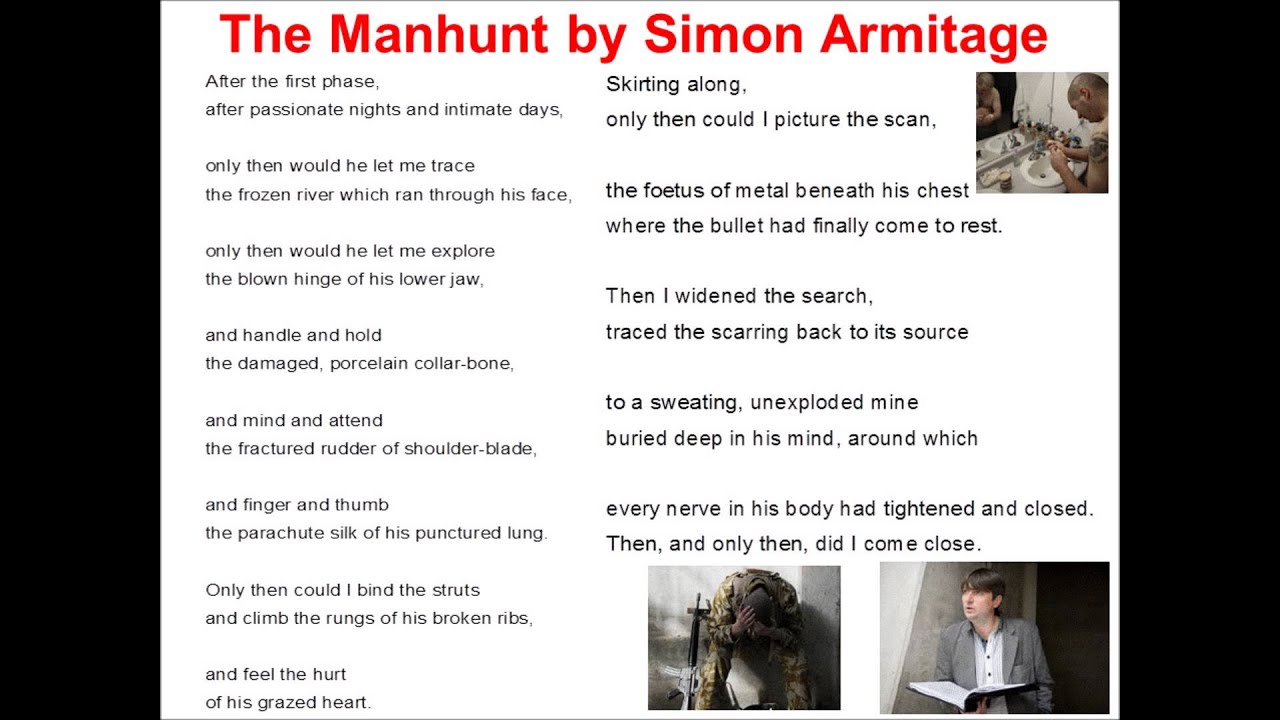
The Manhunt

The Man Hunt


https://www.youtube.com/watch?v=eGX4vwXvek4

The Manhunt Questions

Use these sentence starters to help you:
This suggests
This indicates that
It makes me feel that
The poet tries to convey to the reader the idea of…
Therefore we understand that
This links to the speaker´s message that
The feeling is created by
This shows/proves/highlights….


Answer 10 of the following questions by providing quotes and analysis.

Stanza 1
  1. What does the phrase ‘passionate nights and intimate days’ initially suggest the poem might be about?
  1. What other meanings could ‘passionate’ and ‘intimate’ bring, given the context of the rest of the poem?
Stanza 2
1.     What does ‘only then would he let me trace’ imply?
2.     What might the metaphor ‘the frozen river which ran through his face’ be describing?
3.     What other meaning(s) could ‘frozen’ bring to the poem?

Stanza 3
1.     Why does the narrator use the word ‘explore’ – what connotations does it bring?
2.     The poem is broken up into two-line stanzas.  Why do you think Armitage has used this technique?
3.     What meaning(s) does the phrase ‘blown hinge’ add to the poem?

Stanzas 4-6
1.     Up to now, the couplets have been rhymed; why do you think that Armitage doesn’t rhyme all of the couplets?
2.     Is ‘porcelain’ a good word to describe his collar bone?  Explain your answer fully.
3.     What’s the effect of Armitage’s use of repetition of words and style in these stanzas?
Stanza 7
1.     Armitage starts a new sentence in the poem here; why do you think he does so?
2.     How does this stanza suggest that the narrator is trying to help her husband recover?
Stanza 8
1.     What do you notice about the form of this stanza?  Why might this be important?

Stanzas 9-10
1.     Why does Armitage describe the bullet as a ‘foetus’?
Stanzas 11-12
1.     What sorts of ‘scarring’ is the narrator talking about in these stanzas?
2.     How effective is the metaphor of the ‘mine’ in his mind?  What does the description of it as ‘sweating’ suggest about him?  How does it bring an association of danger?
Stanza 13
1.     What phrase suggests that the narrator is finding it hard to connect to the man?
2.     ‘Then, and only then, did I come close’: close to what?
3.     Look at the last words of each line of the couplet.  What reasons can you think of for Armitage choosing these?  Hint: think about the idea of things which are ‘missing’ or incomplete.
4.     How effective and appropriate is the poem’s title?  Explain your ideas fully.

Thursday, 9 February 2017

Vocab and grammar exam: 23/02 Thursday

- CPE Starter vocab (list in our class quizlet)

- TED Talk vocab: Vocab activities from both talks we have analysed

- Purple Hibiscus vocab: List of words on handout and also themes present in the novel

- CPE word formation style exercises

Friday, 18 November 2016

Adverbs


Most adverbs are formed from an adjective:
easy (-y) + ily        = easily            
complete + ly       = completely  
automatic + ally   = automatically      
horrible (-le) + ly  = horribly  
happy(-y) + ily     = happily        
nice + ly               = nicely          
romantic  + ally    = romantically        
simple   (-le) + ly  = simply


Some adverbs have the same form as an adjective:
close, daily, early, fast, hard, high, right

Adjective  
Susan is fast          (tells the way she is)           fast is an adjective

Adverb      
Susan runs fast       (tells the way she runs)       fast is an adverb

Adverbs of frequency

If the sentence has one verb (e.g. no auxiliary verb) put the adverb of frequency  in the middle of the sentence after the subject and before the verb.
Example: Tom usually goes to work by car.

Come after the verb 'be':
Example: I am never late for work.

If the sentence has more than one verb (e.g. auxiliary verb), put the adverb of frequency before the main verb.
Examples: I can never remember anything!

Adverbs of manner

It cannot be put between a verb and its direct object. The adverb must be placed either before the verb or at the end of the clause.
EXAMPLES
He ate greedily the chocolate cake. [incorrect]
He ate the chocolate cake greedily[correct]
He greedily ate the chocolate cake. [correct]
He gave us generously the money. [incorrect]
He gave us the money generously[correct]
He generously gave us the money. [correct]

USE 1

Adverbs can be used to modify verbs.

Examples:

John walked quickly towards the door.
Sally sat silently waiting for somebody else to speak first.

USE 2

Adverbs can be used to modify adjectives.

Examples:

The redwood tree was impressively tall.
The blouse was outrageously expensive.

USE 3

Adverbs can be used to modify other adverbs.

Examples:

She spoke extremely confidently.
The cheetah ran incredibly quickly.

Adverbs of manner 
Describe how something happens. Where there are two or more verbs in a sentence, adverb placement affects the meaning. Some commonly used adverbs of manner include:

carefully
correctly
eagerly
easily
fast
loudly
patiently
quickly
quietly
well

Adverbs of purpose 
Describe why something happens. Here are some common examples:

accidentally
intentionally
purposely
deliberately

Adverbs of frequency 
Describe how often something happens. The following adverbs are commonly used in this way:

always
every
never
often
rarely
seldom
sometimes
usually

Adverbs of time 
Describe when something happens. These examples are commonly used:

after
already
during
finally
just
last
later
next
now
recently
soon

Advanced adverbs!

half-heartedly
quizically
distractedly
emphatically
impatiently
disinterestedly
eagerly
dismissively
wearily
accusingly

Practice

http://www.englishexercises.org/makeagame/viewgame.asp?id=8387

http://www.englishexercises.org/makeagame/viewgame.asp?id=8386


Vocabulary to Describe a Dramatic Event


Words to convey how terrible something is:
To describe something
Shocking
Distressing
Horrifying
Appalling
Sickening
Devestating

Heartbreaking
To describe feelings
To be shocked
To be distressed
To be horrified
To be appalled
To be sickened
To be devestated
To be heartbroken

Negative words to describe a person
         Evil
Monstrous
Ruthless (no mercy)
Depraved (morally bad)
Crazy
Deranged
Deluded (incorrect judgment)
Insane

Adverbs for Emphasis (Very)
Highly dangerous
Extremely upsetting
Completely crazy
Totally deluded
Extraordinarily heartbreaking

The Man from the South


ACTIVITY 1

For each of the characters, you need to choose the best possible quotations and analyse them...
Step 1 - What characteristics does the character have?
Step 2 - Find good quotations (at least 3) which reveal certain characteristics
Step 3 - Think of a way to infer from the quotation
Step 4 - Use your best, most precise vocabulary in writing your analysis (use the 'explain verbs' handout)

For the oldish man x 2
“...................................”
This could suggest that...

The word ‘......’ emphasises...
“...................................”
This shows...

The reader...

For the cadet x 2
“...................................”
This quotation reflects the cadet’s...

He is also described as “....” which reiterates...
“...................................”
Ostensibly, this quotation...

The effect of this quotation/word is ...


For the narrator x 2
“...................................”
From this passage, the reader can infer that...

However, perhaps...
“...................................”
The reader is given the impression...

This characteristic is repeated later in the story, when...


ACITIVITY 2

How does Roald Dahl build tension in this story? Analyse three different points with quotations.

·      Firstly.../ The opening of the story... / Initially...
Words / Adjectives such as...

·      Gradually...
The reader... / The atmosphere/mood begins to change when...
This is apparent in the passage / quotation...

·      Towards the end of the story, the tension is increased when...
The use of short sentences like ‘...’

Monday, 14 November 2016

Reported Speech

Tense Changes When Using Reported Speech

Normally, the tense in reported speech is one tense back in time from the tense in direct speech:
She said, "I am tired."  She said that she was tired.
The changes are shown below:
Simple presentSimple past
"I always drink coffee", she said
She said that she always drankcoffee.
Present continuousPast continuous
"I am reading a book", he explained.
He explained that he was reading a book
Simple pastPast perfect
"Bill arrived on Saturday", he said.
He said that Bill had arrived on Saturday
Present perfectPast perfect
"I have been to Spain", he told me.
He told me that he had been to Spain
Past perfectPast perfect
"I had just turned out the light," he explained.
He explained that he had just turned out the light.
Present perfect continuousPast perfect continuous
They complained, "We have beenwaiting for hours".
They complained that they had been waiting for hours.
Past continuousPast perfect continuous
"We were living in Paris", they told me.
They told me that they had been living in Paris.
FuturePresent conditional
"I will be in Geneva on Monday", he said


He said that he would be in Geneva on Monday.
Future continuousConditional continuous
She said, "I'll be using the car next Friday".
She said that she would be using the car next Friday.
http://www.perfect-english-grammar.com/reported-speech-exercise-1.html


We use reporting verbs to report what someone said more accurately than using say and tell.

Verb + infinitive

agree, decide, offer, promise, refuse, threaten
  • They agreed to meet on Friday.
  • He refused to take his coat off.

Verb + noun + infinitive

advise, encourage, invite, remind, warn
  • Tom advised me to go home early.
  • She reminded me to telephone my mother.

Verb + gerund

deny, recommend, suggest
  • They recommended taking the bus.
  • She suggested meeting a little earlier.

Verb + noun + preposition (+ gerund)

accuse, blame, congratulate
  • He accused me of taking the money.
  • They congratulated me on passing all my exams.

Verb + preposition + gerund

apologise, insist
  • They apologised for not coming.
  • He insisted on having dinner.

Verb + (that) + subject + verb

admit, agree, decide, deny, explain, insist, promise, recommend, suggest
  • Sarah decided (that) the house needed cleaning.
  • They recommended (that) we take the bus.
Exercises: